

FLEXOO, Germany
The device detects leakage in industrial production plants relying on pipes to convey and transform materials in the form of liquids, such as solvents in chemical factories.
It measures the status of the pipe at given intervals and communicates the pipe´s status wirelessly (e.g via Bluetooth) to the owner of the pipe who can rapidly react to leakage before the liqui spreads and damages the factory or endangers people working there.
Because pipe leakage usually occurs at the joints between pipe segments (flange), they decided to adapt the device to fit at this position.
Functionality
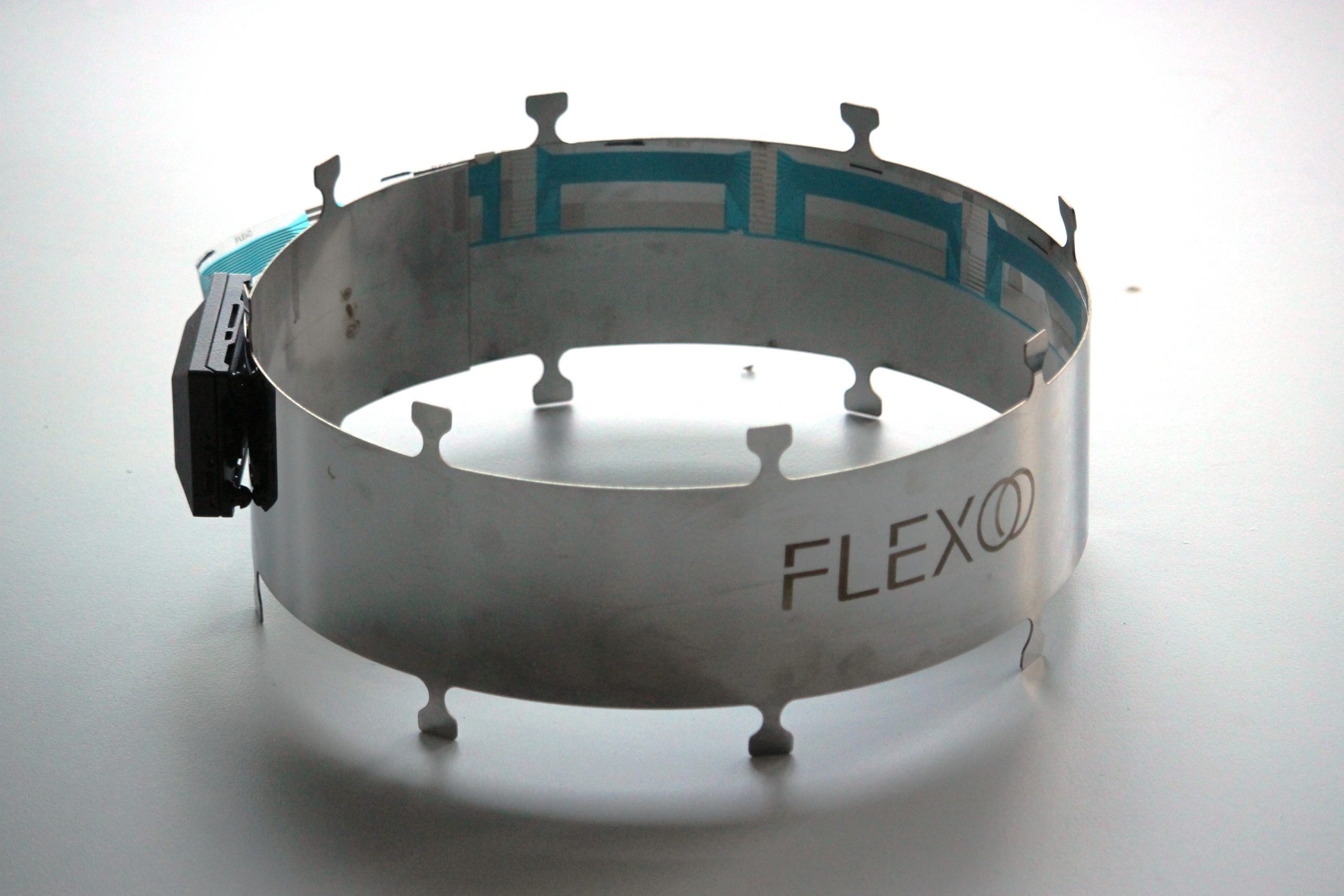
They propose an IoT device comprising a readout electronics and a printed sensing foil, able to detect the presence of liquids (water, solvents and hydrocarbons) in a spacially-resolved manner (using 26 single pixels per foil) and to transmit the data wirelessly to the asset owner.
The device sends via Bluetooth or LoRa the data measured from each sensor individually. Upon contact with a liquid on one or more of the 26 pixels of the sensing foil, the resistance of the sensor changes and local leakage can be detected.
The sensor can be conveniently mounted at the position where leakage occurs most often: at the vicinity of flanges connecting pipe segments.
Benefits of the project
The impact of leakage detection is enormous, in terms of environmental and personnel safety, and costs.
The advantages of our approach are the following:
- a special two channel pixel allowing to differenciate between defect pixel and 0 signal
- an array of N individual pixels allowing to reconstruct a distribution of wetting points withous an crosstalk as it´s usually the case for arrays of resistors
- an easy assembly in the context of pipe leakage detection

Target Industry
- Smart Buildings
- Industrial Asset Monitoring
- Internet of Things
- Consumer Electronics
- Battery Industry
Organic & Printed Components
- Conductive path
- Printed dielectric / insulator
- Printed sensor
Classical Components
- Readout electronics
- Computer