

CENTI, Portugal
High-density electromyography (HD-EMG) has become a critical tool in muscle monitoring, offering more detailed insights into muscle activity compared to traditional EMG techniques. However, current HD-EMG devices face challenges such as size, weight, high cost, limited flexibility, and discomfort, which hinder their use in rehabilitation. To overcome these limitations, our project proposes a novel wearable approach that combines comfort, cost-effectiveness, and clinical usability.
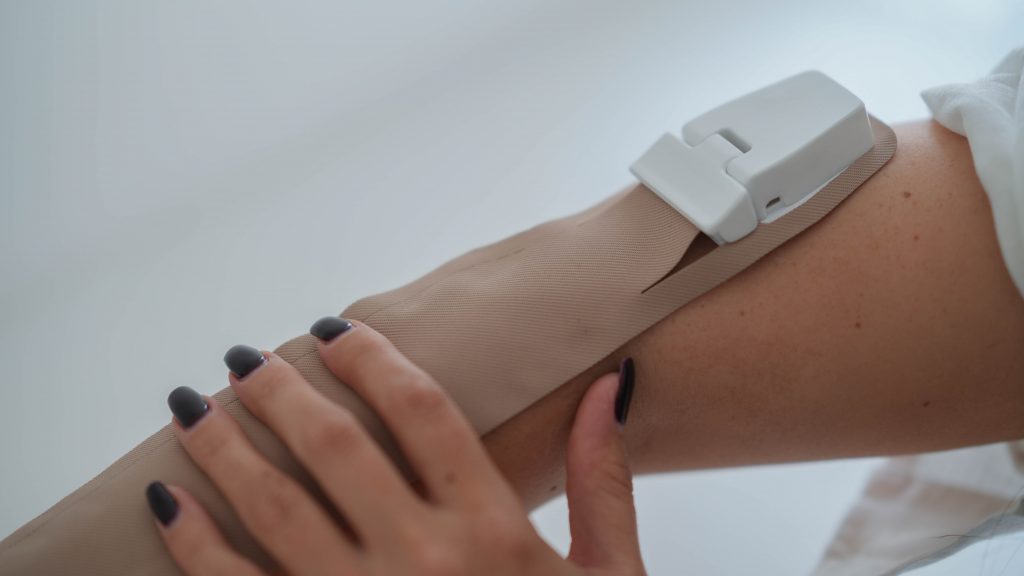
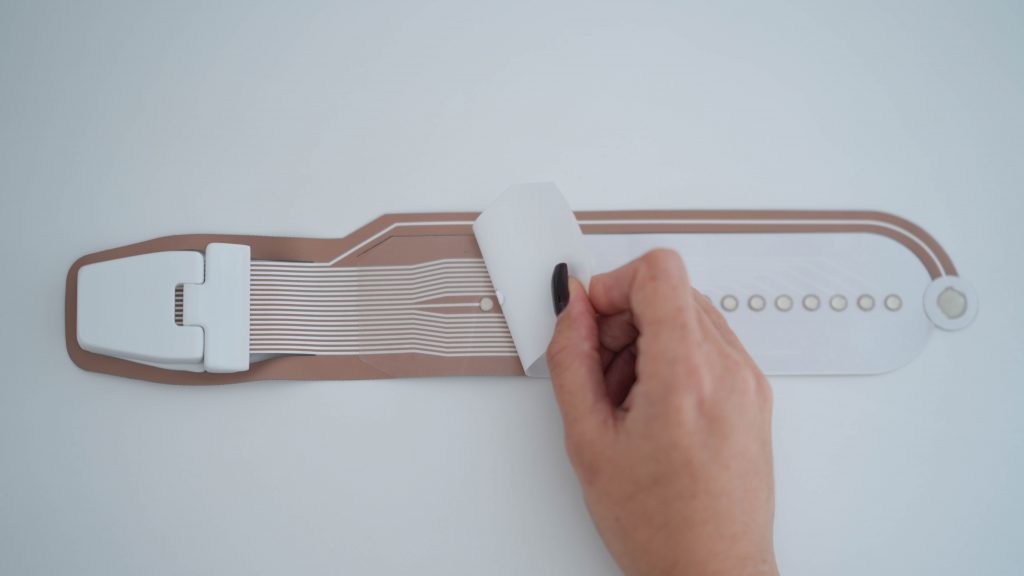
The project comprises a novel wearable textile adhesive patch with integrated HD-EMG sensors for upper and lower limb rehabilitation. The proposed system incorporates a textile matrix with 16 printed electrodes, a temperature sensor, and inertial sensors to monitor muscle activity, temperature, and movement in a lightweight and flexible format. The biocompatible adhesive ensures optimal skin contact, while eliminating the need for bulky cables or electronics. A mobile application provides real-time data to both users and healthcare professionals, enhancing the convenience and effectiveness of rehabilitation process. Additionally, the project explores the use of biodegradable substrates and biocompatible adhesives to improve device performance and sustainability.
Functionality
To use the patch correctly, the carrier is first removed and the patch applied to the targeted muscle. Then, the patch is connected to the control electronics, which is powered on and paired with the mobile app via Bluetooth. Once connected, the patch begins acquiring muscle signals, and rehabilitation commence. Users can perform any exercises suggested by the mobile app. During this process, data are available in real time to the user or healthcare professional, enhancing convenience and effectiveness.
In addition to real-time visualisation, all acquired data are securely stored, allowing users and healthcare professionals to review them later for progress tracking and analysis.
Benefits of the project
High-density electromyography (HD-EMG) has become increasingly important in recent decades due to its ability to provide more detailed and accurate data on muscle electrical activity compared with traditional EMG techniques. HD-EMG consists of a more compact and better-performing high-density electrode matrix, capable of capturing a wide range of motor units throughout the muscle. This allows a detailed analysis of the activation and coordination of motor units, enabling precise assessment of muscle recruitment patterns and the study of fatigue, motor coordination, and neuromuscular dysfunctions. Despite the potential of these solutions, current HD-EMG devices face several challenges, including weight, cost, size, noise, variability in electrode-skin contact, and limited flexibility and adaptability to the body.
To overcome these challenges, we propose a lightweight, flexible that ensures optimal skin contact and measures EMG signals comparable to those obtained with commercial systems, without the constraints of bulky cables or electronics volume. This development involved designing custom circuits and connectors, as well as the developing the hardware, firmware, software, and a mobile application for efficient data communication and display.
Target Industry
- Healthcare
- Neuroscience Research
- Sports Science (Rehabilitation)
Organic & Printed Components
- Conductive path
- Interconnection
- Printed electrode
- Printed sensor
Classical Components
- Sensorsand Interfaces
High-density EMG (HD-EMG) electrodes, printed temperature sensor and Inertial Measurement Unit (accelerometer, gyroscope, and magnetometer) - Acquisitionand ProcessingComponents
Mixed-signal front-end circuits for EMG (analog conditioning + ADC) and microcontroller Unit (MCU) with integrated Bluetooth Low Energy (BLE) for mobile app connection - Connectivityand PowerSupply
USB interface for charging and communication, voltage regulators (LDOs and DC-DC converters), rechargeable battery (Li-Po/Li-ion) and battery management circuitry (charging IC, protection) - SupportComponents
Oscillators / clock generators, passive components (resistors, capacitors, inductors), status indicator LEDs, connectors (for patch-to-electronics connection), and enclosure and printed circuit board (PCB) as physical support