

Hochschule der Medien, Germany
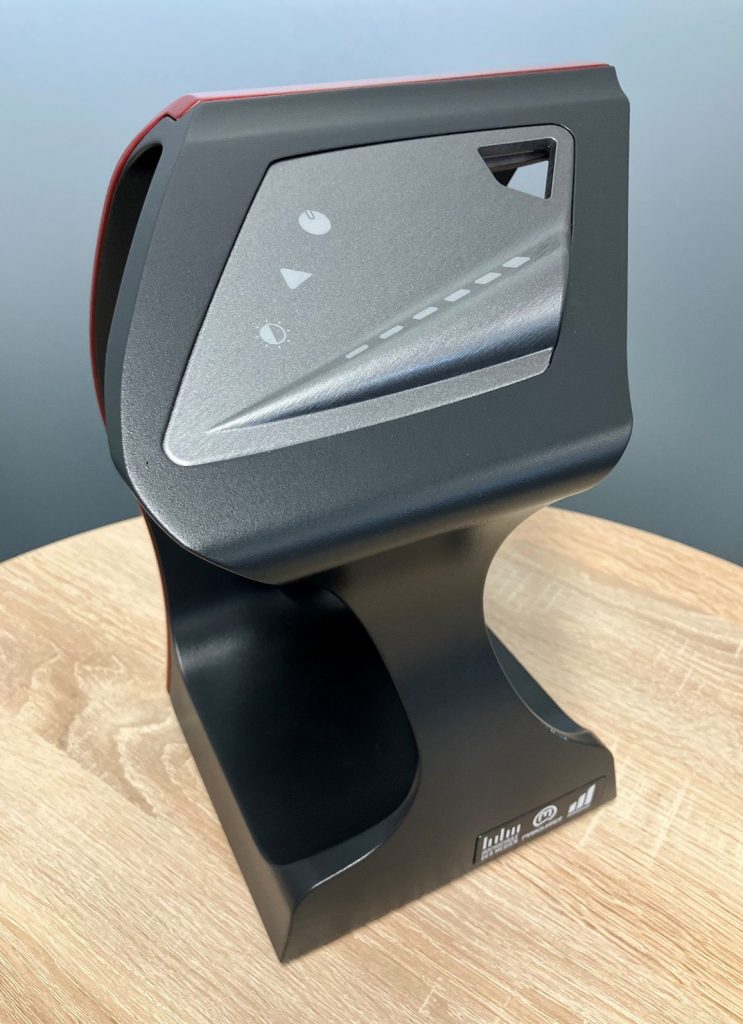
Based on previous developments of a 3D-formed human-machine Interface (HMI) using printed touch sensors (capacitive and piezo-based), which already won the OE-A Competition Award 2023 in the ‚Public Choice‘ category an ultra-thin layer of illumination powered by Micro-LEDs (~20µm) dispersed in a printable paste was added. The entire assembly, including an overmould layer that provides rigidity, has a total thickness of less than 1 mm.
Although the randomly distributed micro-LEDs are reminiscent of a starry night sky, the brightness is much better than that of electroluminescence and equals classic (much thicker) LED lighting.
Functionality
The demonstrator has three buttons and a slider. All are touch-sensitive and are used to control functions such as radio volume, heating or fan speed, e.g. in the cockpit of a car.
Benefits of the Project
The demonstrator shows that it is possible to develop an ergonomic, three-dimensionally shaped control panel for control systems that allows a high degree of design freedom. The special feature is the backlighting of the control elements using a printed layer of micro-LEDs, which enables an ultra-thin design
Target Industry
Since the main project partners primarily serve the automotive industry, this is the primary objective, but the technology developed can also be used for consumer electronics, healthcare, and all applications where touch control with illuminated controls is required.
Organic & Printed Components
- Conductive path
- Printed capacitive switch
- Printed dielectric / insulator
- Printed electrode
- Printed sensor
- Printable layer of micro-LEDs
Classical Components
The micro-LED illumination is driven by a 3V power supply that can be switched on/off and dimmed. The signal from the capacitive sensors is detected by a standard Atmel-based circuitry.